Monday, July 20, 2009

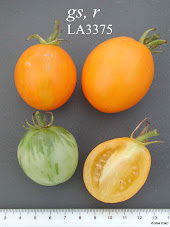
The variety Green Sausage was originally called Green Sleeves by me. I have been crossing an F-5 selection of this clone with some interesting lines to create even more great hanging basket tomatoes that have other colors rather than the green when ripe and stiped Green Sleeves. The vines show a marked determinate growth pattern with a procumbant-prostrate nearly flat to the surface expansion of the canopy.


Sunday, July 12, 2009
I took my neighbor down to look at my potatoes and tomatoes with her new video camera. For a lady of 76 years young she was able to capture me extracting pollen from a Nordic October and emasculating a cluster of flower buds of a Boyd Dude potato variety. We were able to put our heads together to put the video on her laptop and main computer. I am thinking of using part of it on my blog and maybe in Europe.
Anyway, I had some extra pollen of Nordic October (one of my best reds) and went to a potato seedling growing in a raised bed. I emasculated several buds of the yet un-named seedling and proceeded to tell my neighbor of the pedigree. I said that the original line was CT8406-33, a chacoense/tuuberosum hybrid with slightly blue rings in a purple skinned white flesh potato that was but one of some seedling tubers lines bred for high glycoalkoloids in the foliage to repel Colorado Potato Beetles. This line was either selfed or OP'ed and the result was Red Cat, a red skinned, red fleshed line that had lots of berries. I crossed Red Cat to a male parent called Lenape, a white skinned, white flesh line with high glycoalcoloids. The cross led to the Negro y Azul, a very black/blue skin and fleshed line that saw it's origin on some certified organic ground off I-5 near Buttonwillow, California. Negro y Azul was crossed to Kern Toro, one of my best reds at that time, a combination of NorDonna and Fontenot. The cross of Negro y Azul and Kern Toro led to Azul Toro, an excellent early blue flesh variety. I crossed the female Azul Toro with pollen from Blue Blood Russet, a cross of Blue Cat and an unknown russet seedling. The resulting cross was named Paint Jar, an inky black/blue with occasional white patches in the flesh. I crossed the Paint Jar with pollen from Dark Red Norland and this created Paint Nor. Paint Nor was crossed with pollen from October Blue, a cross of Nordic October, a red similar to Kern Toro with the exception of additional germplasm from Red October that had ND2912-2R in it....to Azul Toro, previously mentioned. The two seedlings in the raised bed has one I named last week as Mule Skinner Blues. The other had to be named and I thought of Mostly Purple and I serendipitously named it MOSTLY PURPLE as I crossed it with pollen from Nordic October...knowing fully that I had permission to do so.
Anyway, I had some extra pollen of Nordic October (one of my best reds) and went to a potato seedling growing in a raised bed. I emasculated several buds of the yet un-named seedling and proceeded to tell my neighbor of the pedigree. I said that the original line was CT8406-33, a chacoense/tuuberosum hybrid with slightly blue rings in a purple skinned white flesh potato that was but one of some seedling tubers lines bred for high glycoalkoloids in the foliage to repel Colorado Potato Beetles. This line was either selfed or OP'ed and the result was Red Cat, a red skinned, red fleshed line that had lots of berries. I crossed Red Cat to a male parent called Lenape, a white skinned, white flesh line with high glycoalcoloids. The cross led to the Negro y Azul, a very black/blue skin and fleshed line that saw it's origin on some certified organic ground off I-5 near Buttonwillow, California. Negro y Azul was crossed to Kern Toro, one of my best reds at that time, a combination of NorDonna and Fontenot. The cross of Negro y Azul and Kern Toro led to Azul Toro, an excellent early blue flesh variety. I crossed the female Azul Toro with pollen from Blue Blood Russet, a cross of Blue Cat and an unknown russet seedling. The resulting cross was named Paint Jar, an inky black/blue with occasional white patches in the flesh. I crossed the Paint Jar with pollen from Dark Red Norland and this created Paint Nor. Paint Nor was crossed with pollen from October Blue, a cross of Nordic October, a red similar to Kern Toro with the exception of additional germplasm from Red October that had ND2912-2R in it....to Azul Toro, previously mentioned. The two seedlings in the raised bed has one I named last week as Mule Skinner Blues. The other had to be named and I thought of Mostly Purple and I serendipitously named it MOSTLY PURPLE as I crossed it with pollen from Nordic October...knowing fully that I had permission to do so.

Friday, July 10, 2009
MostlyPurple made my day by posting on my TaterMater Forum. She has some wonderful photos of nine of my potato varieties in full bloom and displaying a few "new" potatoes of such. Not to be totally jealous of her, I put a couple of pictures up to show one of the areas I grow potatoes and the Paint Jar potato as MostlyPurple has in her garden. I am so happy to have customer approval of my seed potatoes. Do I breed potatoes to be flowers? You be the judge!I have posts on my own blog about the sampler I bought earlier this spring...if anyone's interested http://mostlygardening.blogspot.com/2009/07/potatoes-in-bloom.html http://mostlygardening.blogspot.com/2009/07/some-really-new-potatoes.html | ||||


Thursday, July 09, 2009
I am clarifying the photos of blue tomato lines below with some detail.
The first photo on the top left is a cross of Green Zebra X P-20 Blue (#10 2-28-09) and is a plant outdoors in Seattle. Rather cool climate and lots of clouds, but still showing the effects of the male parent which is blue. Note the dark blue shoulders of the fruit exposed to a bit more sunlight due to pruning.
The photo to the right 0f it is #24 of 2-28-09 showing the fruit cluster of Blue P-20 x Woolly Green Zebra. This is also outdoors in Seattle. It has just a bit more foliar cover than #10. Note the slight expression of the woolly gene.
The photo under #10 is also #10 but grown in a high tunnel greenhouse in the mountains of the upper Skagit River. This plant has lots of leaves and vine covering the fruit and therefore shows less purplish on the shoulders. Note the very slight stripes developing, typical of Green Zebra crosses.
The photo to the right of it shows the P-20 Blue outdoors again in Seattle. Poor cover is allowing the fruit to purple up. The cross tag shows a fruit crossed to a red tomato with the pedigree of Silvery Fir Tree X Pineapple-Elberta Girl. Nicely cut leaves with extreme woolly leaves and very early. The #25 3-309 tag shows the pollen used for the F-1 seed developing.
The bottom picture shows #9 2-28-09 (Blue P-20) as grown in the high row tunnel greenhouse in the upper Skagit area. Lots of foliage covering this fruit and had to push away about two foot of leaves. The plants are left to sprawl naturally so a a dense shade is protecting the fruit from coloring up. All of the fruits are very immature but show the effects of the blue genes.
The first photo on the top left is a cross of Green Zebra X P-20 Blue (#10 2-28-09) and is a plant outdoors in Seattle. Rather cool climate and lots of clouds, but still showing the effects of the male parent which is blue. Note the dark blue shoulders of the fruit exposed to a bit more sunlight due to pruning.
The photo to the right 0f it is #24 of 2-28-09 showing the fruit cluster of Blue P-20 x Woolly Green Zebra. This is also outdoors in Seattle. It has just a bit more foliar cover than #10. Note the slight expression of the woolly gene.
The photo under #10 is also #10 but grown in a high tunnel greenhouse in the mountains of the upper Skagit River. This plant has lots of leaves and vine covering the fruit and therefore shows less purplish on the shoulders. Note the very slight stripes developing, typical of Green Zebra crosses.
The photo to the right of it shows the P-20 Blue outdoors again in Seattle. Poor cover is allowing the fruit to purple up. The cross tag shows a fruit crossed to a red tomato with the pedigree of Silvery Fir Tree X Pineapple-Elberta Girl. Nicely cut leaves with extreme woolly leaves and very early. The #25 3-309 tag shows the pollen used for the F-1 seed developing.
The bottom picture shows #9 2-28-09 (Blue P-20) as grown in the high row tunnel greenhouse in the upper Skagit area. Lots of foliage covering this fruit and had to push away about two foot of leaves. The plants are left to sprawl naturally so a a dense shade is protecting the fruit from coloring up. All of the fruits are very immature but show the effects of the blue genes.


Saturday, July 04, 2009

I run into folks who rarely ever see potato berries on their potato vines. When they do find them they will ask why they don't see more of them. Potato berries, seed balls, potato fruits, etc., are not how most people see next year's crop like I do, nevertheless, I get a myriad of questions to the point where I see a need to organize a primer of sorts, namely;
WEB TOPIC, WHO, WHAT, WHEN, WHERE, HOW, WHY of Potato Berries.
I talk in circles about my potatoes, losing everybody in the wake, but every now and then........I combine statistics, musings, and experience in hope of making silly, ignorant questions thrown at me seem erudite being I may have a proper response to many questions (implied or impishly) surfacing.
Is there a simple answer to the questions of why some people have potato berries and others don't? No, but that doesn't stop me from using some stats to make it interesting to me. I ask myself these questions similar to this all the time----- all of the 56 years I have been breeding potatoes.
I am also a tomato breeder and I have to save seed. Why can't I just save seed all the time with potatoes? You mean ter say that a potato fella can be a true seedsman rather than just another YouTuberman?
The most obvious question to ask is...Do most potato varieties set berries?....the answer is No! What follows is the evidence, etc.
http://www.europotato.org/display_character.php?char_no=23&character=Berries
1. No berries 463 varieties
2. Very rare 236
3. Rare 288
4. Rare to occasional 74
5. Occasional 134
6. Occasional to frequent 47
7. Frequent 129
8. Frequent to v aery frequent 7
9. Very frequent 14
1392--The number of varieties in the European Potato Database comparing berry occurrence. Yes, it does include a lot of American varieties.
Note that on this list 987 out of 1392 will have either
(1) No Berries
(2) Very Rare or
(3) Rare
That means about 70% of all varieties will not set berries as a rule.
Note conversely, that 21 varieties fall into the last two categories:
(8) Frequent to very frequent or lastly--
(9) Very Frequent
That means that the extreme likelihood of having one of these varieties is just slightly more than 1%, or one out of 66.
Below is the list of the categories (8) and (9):
BF 15
Claustar
Keltia
Kerpondy
Leksands Vit
Mirakel
Record
Aranykincs
Cara
Comle (1964)
Desiree
Dr McIntosh
Granola
Inca Sun
Kameraz
Mayan Gold
Morene
Nemes Rozsa
Orion (1947)
Revelino
Tone
I have grown about 11 of these, soon to grow another one if the tubers arrive, and I would say that Granola and Leksands Vit fall easily into these categories of nearly always having berries, but ones like Morene, Desiree, and Record fall short. The only variety most folks on TVille might have in their garden is Desiree.
I noticed that the Potato Pedigree database shows Granola used 18 out of 25 times as a male (pollen) parent. Conversely, a variety like Agria which never has berries is used as a female parent in almost all of the 66 times it shows up as a parent. There were a few pedigrees that show it as a male but that has to be an error of record keeping. Just try to get any pollen out of an Agria flower.
129- The number of varieties that are listed as frequent in making berries. I have grown about 25 of those in the list and I concur that Atlantic, Katahdin, Vestar, Saturna, Stina, Hindenburg, Boxer, Pentland Dell, etc. fall into this category. Most years you will see some to many berries on these lines but not always. Are any of these in my potato varieties? Yes, all of them, thank goodness!
I think one of the many reasons we have so many varieties listed as having few, if any berries, is that we tend to use them a lot as female parents. They are easy to use since you don't even have to emasculate the flowers. But the unwitting role that plays is that the roll of the dice is creating more and more varieties that are poor berry makers. The genesis of poor berry setters has to do with the maternal lines with historical poor berry setting factoring heavily in the descent of offspring.
I have a habit of selecting potential parents that are good in producing lots of pollen and set their own berries without having to rely on insect pollination or my crossing to them. In other words, good OP lines. which really means good selfing lines. By putting together parent blocks (varieties planted in small numbers in a tight plots) of varieties that are versatile in both directions in a cross, I am creating a population that will carry the selfing ability into the ensuing populations of TPS. That is one reason I have so many good berry makers and most other folks do not. A variety that produces its own berries and for year after often ends up in many crosses, thus is a valuable resource for me.
Too many times a seedling line grown from true seed will produce berries but after growing the plants from tubers will sometimes be reluctant to produce berries. Those lines get dropped quite easily from the parent blocks for the third year. Nordic October is a red variety that has always produced berries even if it was infected with a virus. Since I had the variety cleaned up through meristem tissue procedures, I have been using it in so many crosses that I find it several times in the pedigree of some my recent lines and many of these new lines are great berry makers.
ct
I do believe that during the evolution of creating and preserving cultivars of potato varieties..... that an unwittingly desire for non-berry makers has shifted because the lines that do well under near perfect conditions of agronomic actions just don't have the survival instincts to produce berries. The timing and auxin of the tuberization inhibit the fruiting instincts and the abscission zones abort the flowers since the pull of nutrients is redirecting itself from the plant to the tubers. The big growers kinda like the varieties that are absent berries, and when the plants do set berries it is usually due to an adverse environmental stress such a water stress, injury, tillage, etc.
I will be video recording many of my potato plots this year showing berry formation, crosses, etc. in conjunction with varieties from all over the world with me talking about the attributes of many of my lines that favor berry set.
These videos will show hundreds if not thousands of new clones that will disprove the adage that potato varieties rarely set fruit. It will show the interested audiences that there IS a potato breeder willing to chart a new paradigm of potato production.
I would go so far as to say I am the only potato breeder that gives the number one priority not to disease tolerance, yield, flavor, etc., but to berry setting!
Tom Wagner
AKA TaterMater
WEB TOPIC, WHO, WHAT, WHEN, WHERE, HOW, WHY of Potato Berries.
I talk in circles about my potatoes, losing everybody in the wake, but every now and then........I combine statistics, musings, and experience in hope of making silly, ignorant questions thrown at me seem erudite being I may have a proper response to many questions (implied or impishly) surfacing.
Is there a simple answer to the questions of why some people have potato berries and others don't? No, but that doesn't stop me from using some stats to make it interesting to me. I ask myself these questions similar to this all the time----- all of the 56 years I have been breeding potatoes.
I am also a tomato breeder and I have to save seed. Why can't I just save seed all the time with potatoes? You mean ter say that a potato fella can be a true seedsman rather than just another YouTuberman?
The most obvious question to ask is...Do most potato varieties set berries?....the answer is No! What follows is the evidence, etc.
http://www.europotato.org/display_character.php?char_no=23&character=Berries
1. No berries 463 varieties
2. Very rare 236
3. Rare 288
4. Rare to occasional 74
5. Occasional 134
6. Occasional to frequent 47
7. Frequent 129
8. Frequent to v aery frequent 7
9. Very frequent 14
1392--The number of varieties in the European Potato Database comparing berry occurrence. Yes, it does include a lot of American varieties.
Note that on this list 987 out of 1392 will have either
(1) No Berries
(2) Very Rare or
(3) Rare
That means about 70% of all varieties will not set berries as a rule.
Note conversely, that 21 varieties fall into the last two categories:
(8) Frequent to very frequent or lastly--
(9) Very Frequent
That means that the extreme likelihood of having one of these varieties is just slightly more than 1%, or one out of 66.
Below is the list of the categories (8) and (9):
BF 15
Claustar
Keltia
Kerpondy
Leksands Vit
Mirakel
Record
Aranykincs
Cara
Comle (1964)
Desiree
Dr McIntosh
Granola
Inca Sun
Kameraz
Mayan Gold
Morene
Nemes Rozsa
Orion (1947)
Revelino
Tone
I have grown about 11 of these, soon to grow another one if the tubers arrive, and I would say that Granola and Leksands Vit fall easily into these categories of nearly always having berries, but ones like Morene, Desiree, and Record fall short. The only variety most folks on TVille might have in their garden is Desiree.
I noticed that the Potato Pedigree database shows Granola used 18 out of 25 times as a male (pollen) parent. Conversely, a variety like Agria which never has berries is used as a female parent in almost all of the 66 times it shows up as a parent. There were a few pedigrees that show it as a male but that has to be an error of record keeping. Just try to get any pollen out of an Agria flower.
129- The number of varieties that are listed as frequent in making berries. I have grown about 25 of those in the list and I concur that Atlantic, Katahdin, Vestar, Saturna, Stina, Hindenburg, Boxer, Pentland Dell, etc. fall into this category. Most years you will see some to many berries on these lines but not always. Are any of these in my potato varieties? Yes, all of them, thank goodness!
I think one of the many reasons we have so many varieties listed as having few, if any berries, is that we tend to use them a lot as female parents. They are easy to use since you don't even have to emasculate the flowers. But the unwitting role that plays is that the roll of the dice is creating more and more varieties that are poor berry makers. The genesis of poor berry setters has to do with the maternal lines with historical poor berry setting factoring heavily in the descent of offspring.
I have a habit of selecting potential parents that are good in producing lots of pollen and set their own berries without having to rely on insect pollination or my crossing to them. In other words, good OP lines. which really means good selfing lines. By putting together parent blocks (varieties planted in small numbers in a tight plots) of varieties that are versatile in both directions in a cross, I am creating a population that will carry the selfing ability into the ensuing populations of TPS. That is one reason I have so many good berry makers and most other folks do not. A variety that produces its own berries and for year after often ends up in many crosses, thus is a valuable resource for me.
Too many times a seedling line grown from true seed will produce berries but after growing the plants from tubers will sometimes be reluctant to produce berries. Those lines get dropped quite easily from the parent blocks for the third year. Nordic October is a red variety that has always produced berries even if it was infected with a virus. Since I had the variety cleaned up through meristem tissue procedures, I have been using it in so many crosses that I find it several times in the pedigree of some my recent lines and many of these new lines are great berry makers.
ct
I do believe that during the evolution of creating and preserving cultivars of potato varieties..... that an unwittingly desire for non-berry makers has shifted because the lines that do well under near perfect conditions of agronomic actions just don't have the survival instincts to produce berries. The timing and auxin of the tuberization inhibit the fruiting instincts and the abscission zones abort the flowers since the pull of nutrients is redirecting itself from the plant to the tubers. The big growers kinda like the varieties that are absent berries, and when the plants do set berries it is usually due to an adverse environmental stress such a water stress, injury, tillage, etc.
I will be video recording many of my potato plots this year showing berry formation, crosses, etc. in conjunction with varieties from all over the world with me talking about the attributes of many of my lines that favor berry set.
These videos will show hundreds if not thousands of new clones that will disprove the adage that potato varieties rarely set fruit. It will show the interested audiences that there IS a potato breeder willing to chart a new paradigm of potato production.
I would go so far as to say I am the only potato breeder that gives the number one priority not to disease tolerance, yield, flavor, etc., but to berry setting!
Tom Wagner
AKA TaterMater
Wednesday, April 22, 2009

This is taken freely from my friend's blog at mutually assured survival dot com. Nice take on my work.
"More protein per acre than soybeans"
That's famed crop breeder Tom Wagner lining up some potatoes that he bred. Mr. Wagner is best known for his tomato "Green Zebra", which is notable for its beautiful stripes and tangy flavor.
He also breeds potatoes. Potatoes are roughly the most productive crop you can grow in most temperate climates. They also happen to be a bit more nutritious than usually given credit for. They are not "pure starch", but in fact contain roughly 2% fairly high-quality protein. The percentage of protein is low, but potatoes are so prolific that you still end up with 500-1000kg of protein per year per hectare of potatoes, versus 164-500kg of protein from soybeans, 98-300kg of protein from wheat, and only 33kg protein from milk produced by cows.
The protein by the way is found almost entirely right under the skin--it's in the yellowish layer you see when you gently peel just the outermost skin from the potato--which is why you should never peel potatoes (you're throwing all their protein content away), but instead always cook them unpeeled and then carefully pull the skin off.
Potatoes are surprisingly rich in other nutrients. They contain the B vitamins and are surprisingly rich in B6, and contain plenty of vitamin C. If they have yellowish flesh then they usually have significant amounts of carotenoids, which are a precursor to vitamin A that your body can use to make vitamin A.
Sunday, February 22, 2009
Program so far:
- September 12 Morning lecture at Chateau de la Bourdaisiere. Tomato show. 2 days. (Then super fast train to north of France)
- September 12 Evening lecture at Haverskerque. Tomato show on 13th. Huge one.
- September 15/16 workshop in Belgium dans la région de Bruxelles
- September 22/23 workshop in Chateau de la Bourdaisiere
- September 25/26 workshop in Morlaix, Brittany
- October 3/4 workshop in Switzerland la région du Lac Léman
http://tinyurl.com/c68noj shows where some of the seminars are in a translated (slow to load) link.
- September 12 Morning lecture at Chateau de la Bourdaisiere. Tomato show. 2 days. (Then super fast train to north of France)
- September 12 Evening lecture at Haverskerque. Tomato show on 13th. Huge one.
- September 15/16 workshop in Belgium dans la région de Bruxelles
- September 22/23 workshop in Chateau de la Bourdaisiere
- September 25/26 workshop in Morlaix, Brittany
- October 3/4 workshop in Switzerland la région du Lac Léman
http://tinyurl.com/c68noj shows where some of the seminars are in a translated (slow to load) link.
Saturday, January 24, 2009
http://www.kokopelli.asso.fr/
This picture of me is linked to the Kokopelli website


Thursday, August 21, 2008
I have created many kinds of tomatoes, but potato breeding touches the deepest part of my soul and it is the most satisfying. Why would I refer to the soul? Definitions abound:
The animating and vital principle in humans, credited with the faculties of thought, action, and emotion and often conceived as an immaterial entity. The spiritual nature of humans, regarded as immortal, separable from the body at death, and susceptible to happiness or misery in a future state
Why would a potato breeder combine material and immaterial entities? Plant breeding has been a calling for me, however, I have no congregation outside the readership of this blog. I do not expect people to understand me, hardly in the slightest, but to do what I do means a singular ambition, answerable to no one, but my activities still beg for an audience.
In my attempt to create new types of potatoes, I stumble upon crosses that I make that stir my imagination in many ways. When I dug my variety that I call NAVAMEY, I was impressed with the vine and the natural production of many potato berries that are likely selfed with an occasional out cross. The potato vine is a breeder’s dream, a round russet with yellow flesh with just the right size plant, maturity, and yield.
Looking at the cross extracted today between NAVAMEY and LUMPER, I was struck by the memory of the pedigree background coming full circle; namely the Irish connection. Since the weather here in the PNW is much like where my grandfather Joe Kaighin lived until he was 21 near the Irish Sea on the Isle of Man, I was hoping to get some more germplasm that would complement my endeavor of keeping his potato growing spirit alive.
The LUMPER did very well this year in one or more patches; good yields and good flavors. Since I am the only one doing breeding work with this two hundred year old potato variety, the progeny of my breeding work may some day be released to the public.
The LUMPER is uniquely suited to organic production and does well in a broad range of soil types. Breeding away from its Irish Famine history of Late Blight susceptibility, I hope I can re-acquaint people with better selections of this heritage potato!
I make painstaking trouble to record my breeding work. As follows is a breakdown of the pedigree.
F-1 of NAVAMEY X LUMPER
WASHINGTON 2008 TPS only
Pedigree: S 62-47-1 x MARIS PIPER
Great Brittain 1987
Exp. # L 2651/2088
NORTHERN IRELAND PLANT BREEDING STATION
Pedigree USDA B 6987-145 x USDA B 7805-1
USA 1999
Exp. # USDA B 9922-11
GOLD PAN
Pedigree BLACK HILLS GOLD X PLACER GOLD
CALIFORNIA 1995 (TATER MATER SEEDS)
GOLDEN AMEY
Pedigree AMEY X GOLD PAN
California 1999 (TATER MATER SEEDS)
NAVAMEY
Pedigree NAVAN X GOLDEN AMEY
WASHINGTON 2006 (TATER MATER SEEDS)
Pedigree UKN
Scotland to Munster (SW Ireland) 1810 or before
Tom Wagner aka Tater Mater
Subscribe to:
Posts (Atom)